Your competitors publish their whole advertising strategy in the Meta and Google ad libraries. Almost nobody reads it properly. This does, and hands your creative team a ranked queue of briefs with the evidence attached and the proposed ad already mocked up.
Category readout · Page one · Names redacted
Only one ad in twenty becomes a winner when concepts are guessed. Briefs built on what the category has already proven, and on the argument nobody is making, raise the odds of every test. More winners from the same budget.
The research and briefing weeks disappear. Briefs arrive in priority order with the offer, angle and format decided and the ad mocked up from your own assets. Monday starts with production, not debate.
Winning ads fatigue in two to three weeks on Meta. A queue that never runs dry keeps fresh winners in rotation, and brands that lift their creative velocity see cost per acquisition fall by 20 to 33%.
Meta and Google, every live ad, with how long it has run and what it claims.
Ideas, not screenshots. Which arguments the category makes, who runs them, and the one that is missing.
Each commercial claim in the category with the capture it came from and a verdict: beat it, match it, or decide.
A ranked directory of briefs, each with its evidence and a mock of the proposed ad at the real aspect ratio.
Pages from a live round, set larger for the screen. The client, the competitors, the category and the evidence lines are redacted; everything else is as delivered.
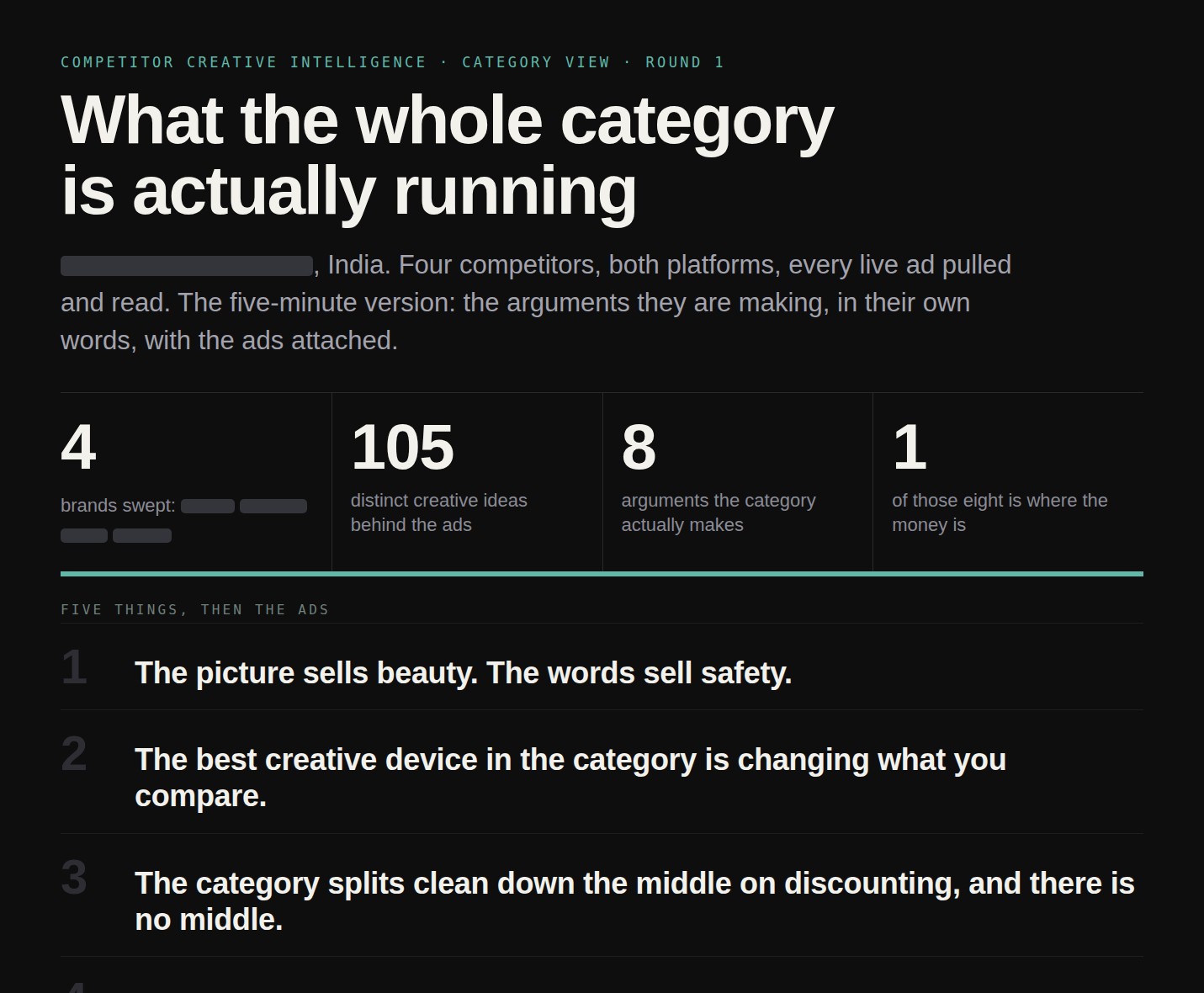
Founder version · Page one
Five findings, then the ads. Readable in one sitting.
Brief directory · Cover
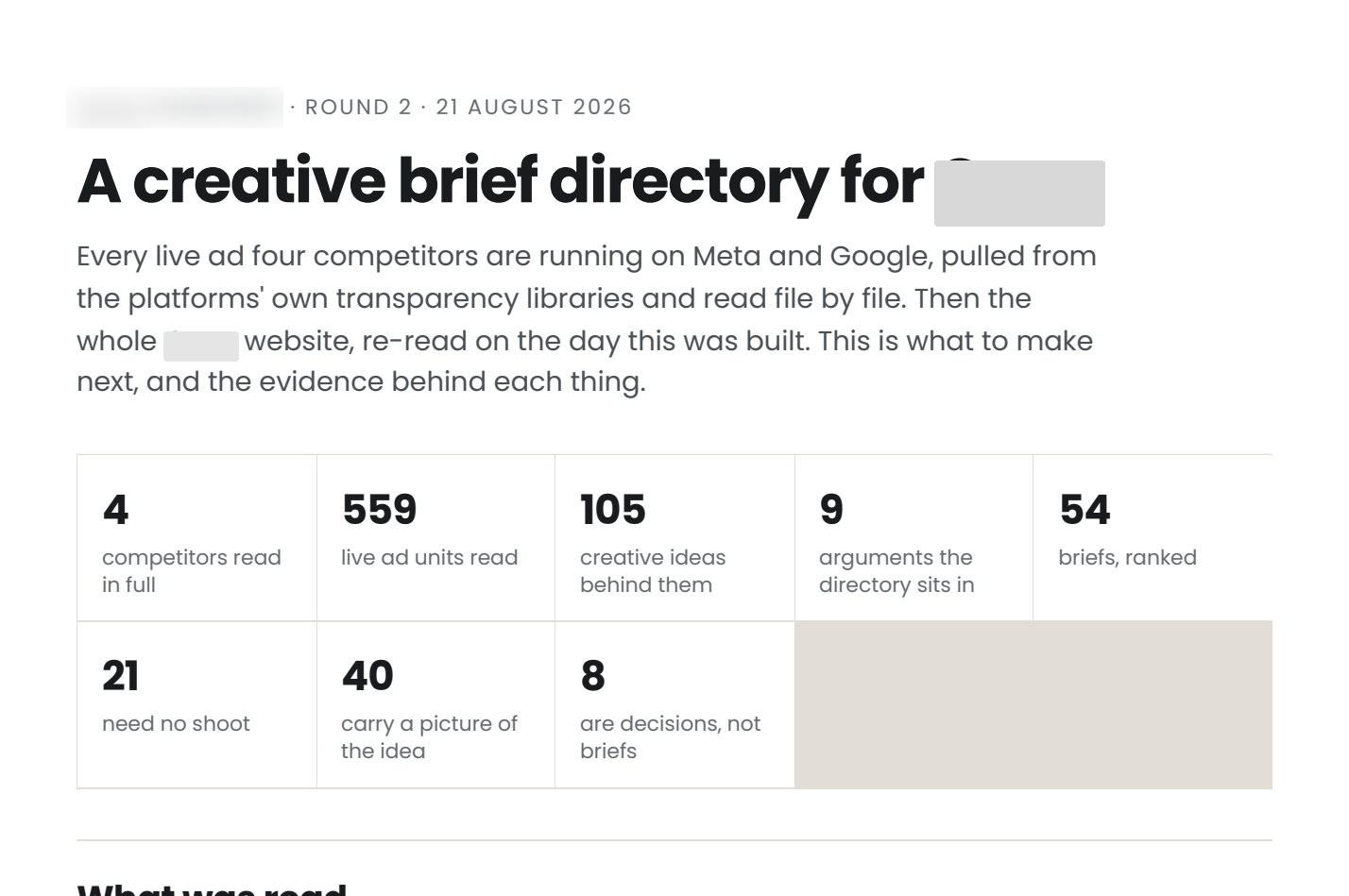
54 briefs, ranked. 21 of them need no shoot.
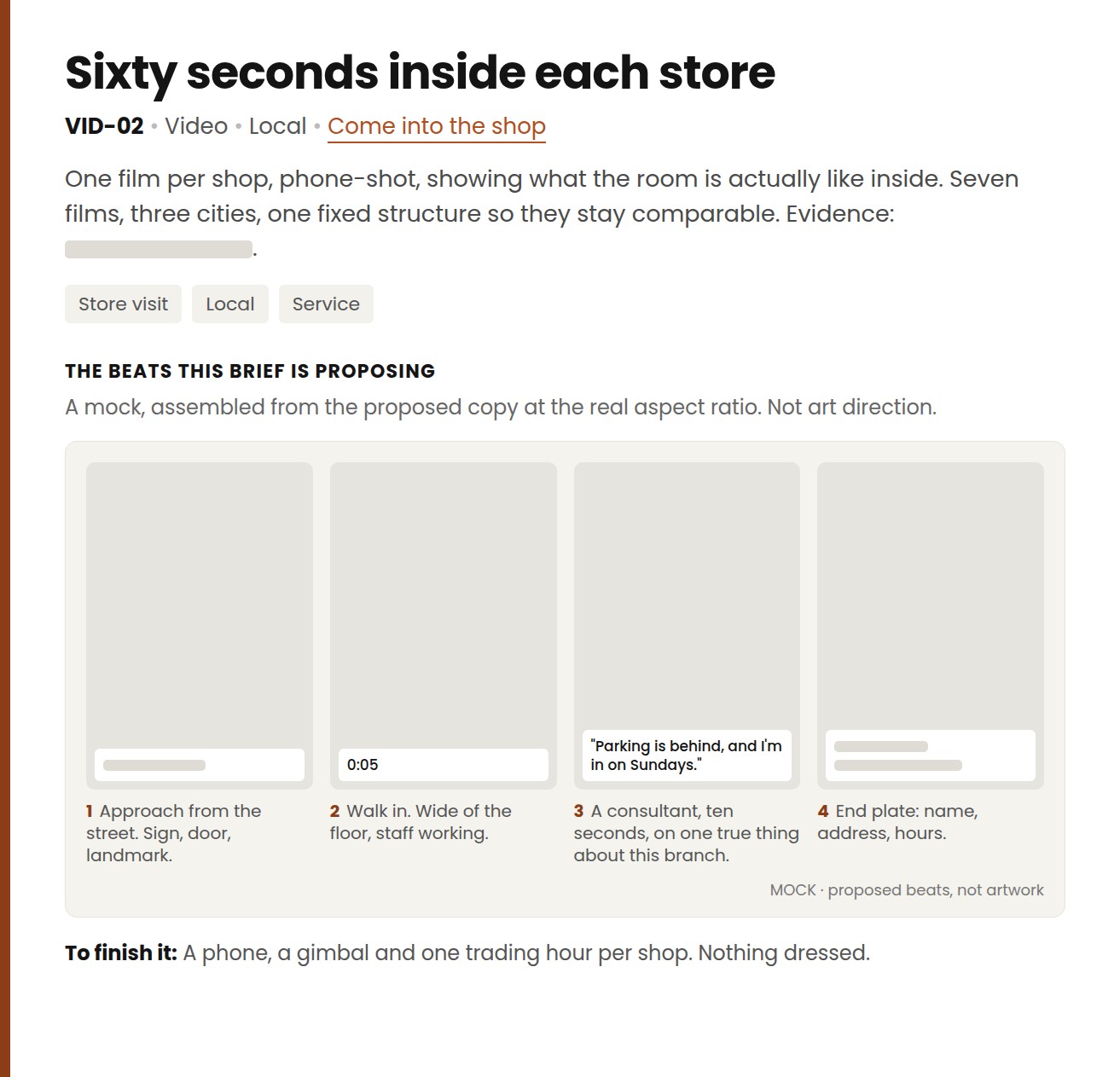
One brief · Video · Local
The beats, mocked at the real aspect ratio. A designer executes directly.
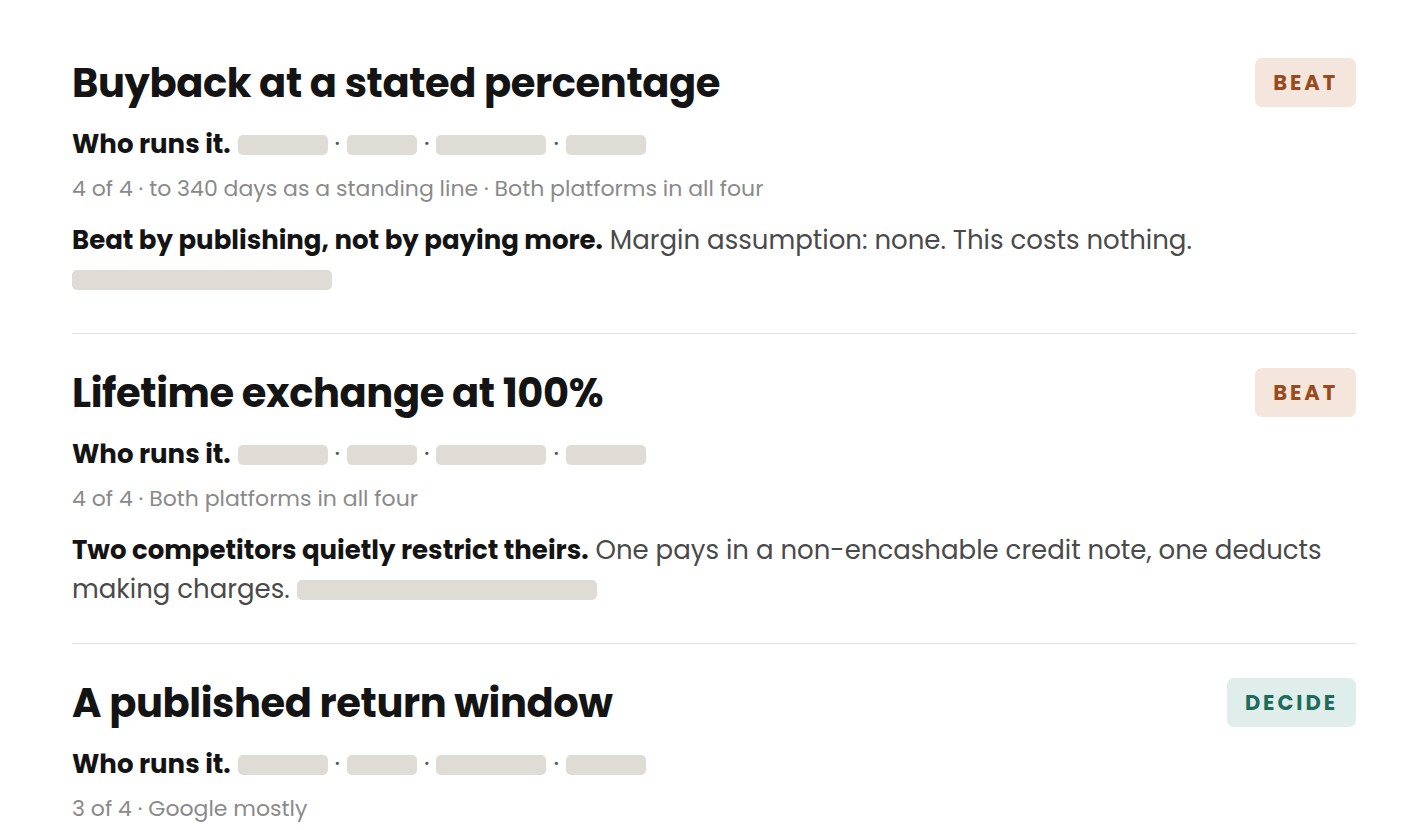
Offers dossier · Page two
Every claim in the category, with a verdict and the capture behind it.
The reading never knows who the client is until the last step, so it describes the category instead of flattering the brand.
Every claim carries the ad or the capture it came from, with the date it was seen.
Media is hashed and archived, so a creative running under six ad IDs counts once and can be reopened later.
A separate pass checks the output against the evidence. Then an experienced marketer reads it again.
Every creative plan used to start with twenty minutes in the ad library and an opinion. The opinion was usually fine. It was also unfalsifiable, and two months later nobody could say what the competitor had been running when the plan was written.
Now the category is read in full before anyone in the room has a view, and the briefs arrive with their evidence attached. The opinions still matter. They just start from the same facts.
A brief that does not show the ad is not a brief.
Two lines on the brand and the competitors you watch is enough to start.
Two lines on the outcome you are after. That is enough to start.
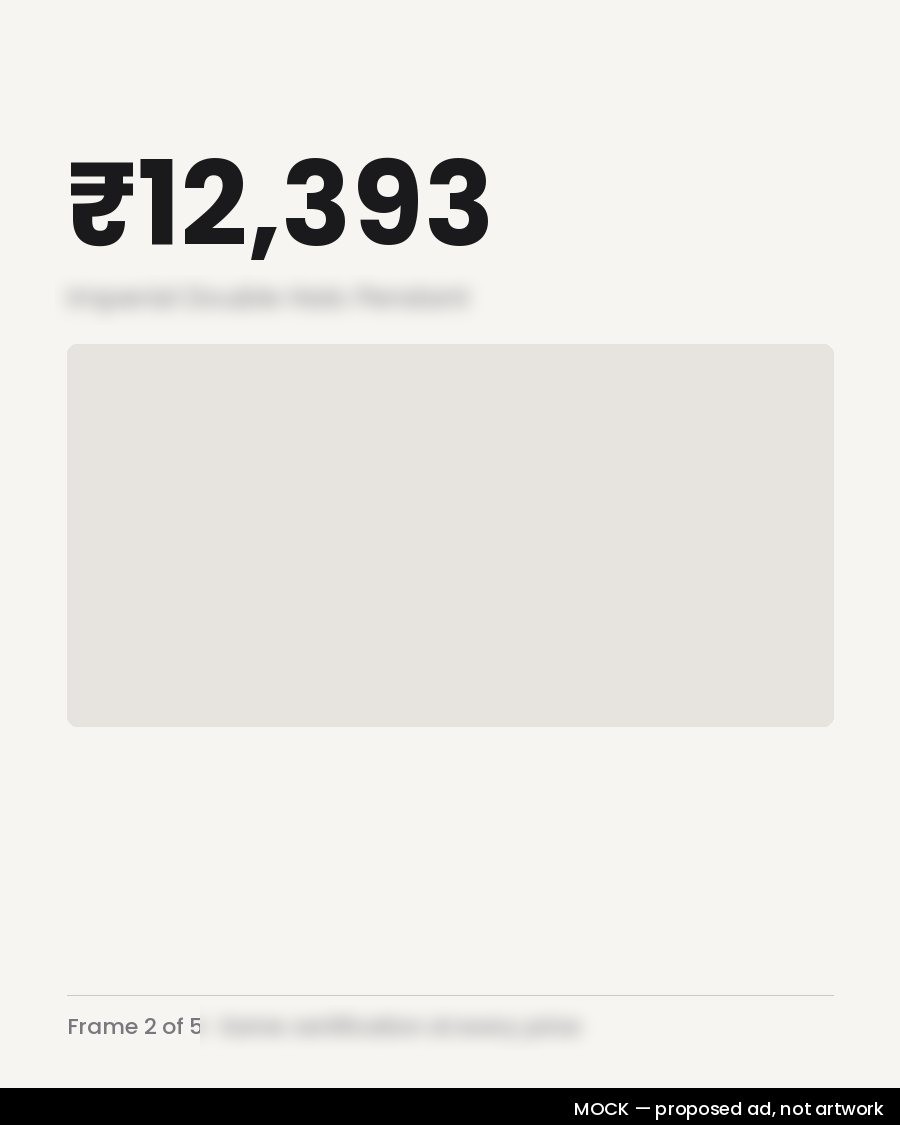
Mock · The proposed ad, from the brief
Numbers marked est. are projections from published benchmarks (Motion Creative Benchmarks 2026, Admetrics, Monotype 2025) applied to our first rounds, not yet measured across our clients.